
Interest rates on hold but not off the table. Home values cooling. Tax reform dominating the headlines. For Sydney landlords, none of this is the story that actually decides your rental income this year.
Winter has settled over Sydney’s property market, and so has the noise. The story that determines what your property earns this year isn’t playing out in auction rooms or in Canberra — it’s playing out in vacancy rates, leasing turnaround times, and the standard of the team managing your property day to day. Here’s what the data says, and what it means for you.
READING THE MARKET RIGHT NOW
The Reserve Bank left the cash rate on hold at 4.35% at its June meeting, with the next decision due 11 August. That’s not the reassurance it sounds like. Underlying inflation — the trimmed mean, which strips out one-off swings — accelerated to 3.6% in May, well above the RBA’s target band, and the Bank has been upfront that another rate rise remains on the table.
Sydney dwelling values have cooled alongside this, easing from last year’s cyclical highs as auction clearance rates spent much of winter below 50% before recovering to 54.8% in mid-July. Nationally, values are still 7.3% higher than 12 months ago — this reads as a market cooling, not collapsing, and one where the quality of the individual asset, and how it is managed, increasingly matters more than the direction of the headlines.
The more important number for landlords sits on the other side of the ledger. Rental conditions have barely softened at all. National vacancy remained near record lows through the June quarter, and Sydney rental listings sat 24.1% below the five-year average. Sydney median house rents hit a record $850 a week in the June quarter — up 6.3% in just three months, the fastest quarterly pace in four years. Whatever else is cooling in this cycle, tenant demand for well-managed rental stock is not one of them.
THE STRUCTURAL STORY BEHIND THE HEADLINES
This isn’t a temporary squeeze. Australia is now more than 112,000 homes behind the pace needed to meet the National Housing Accord’s target of 1.2 million new homes by 2029, and construction timelines have stretched across every dwelling type over the past seven years. Combined with net migration tracking around 230,000 people a year — the large majority of whom rent for at least their first five years here — the shortage underpinning rental demand is structural, not cyclical.
Layered on top of that is a genuine policy shift. For established residential properties purchased under contracts signed after 7:30pm on 12 May 2026, negative gearing will be removed for new purchases, with existing holdings grandfathered, alongside a restructured capital gains tax treatment. Some landlords are already adjusting their long-term plans in response, and several market analysts have flagged that reduced participation from established-property owners could tighten rental supply further before conditions ease.
None of this is cause for alarm. But it is a signal: this is a market that increasingly rewards properties under professional, well-structured management, and leaves passively managed properties more exposed to vacancy, rent leakage and compliance risk than in a calmer cycle.
That is precisely where property management stops being a back-office service and becomes the variable that determines your actual return.
THE PIA H1 2026 TRACK RECORD
PIA was founded in 2005. Today, we concentrate on one thing only: managing rental properties for Sydney landlords, and supporting the resale of established homes if needed. In 2022, we permanently stepped back from broader sales brokerage to keep our focus exactly here. As one of Sydney’s largest dedicated property management groups, we now manage properties for more than 5,000 landlords across the city — and we publish our numbers because performance, not promises, is what should earn your trust.
June 2026, at a glance
H1 2026, at a glance
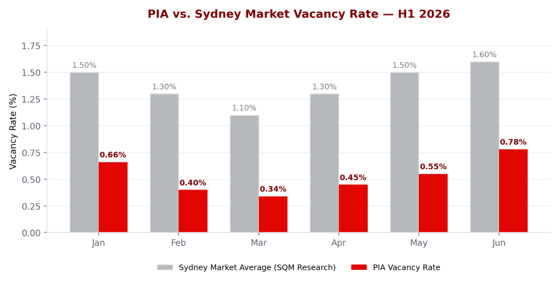
Across the first half of 2026, PIA maintained an average vacancy rate of 0.53% against a Sydney market average of 1.38% (SQM Research) — a gap of 0.85 percentage points sustained in every single month, including a record low of 0.34% in March.
| 2026 Month | Sydney Market Avg. (SQM) | PIA Vacancy Rate |
|---|---|---|
| January | 1.50% | 0.66% |
| February | 1.30% | 0.40% |
| March | 1.10% | 0.34% |
| April | 1.30% | 0.45% |
| May | 1.50% | 0.55% |
| June | 1.60% | 0.78% |
| H1 Average | 1.38% | 0.53% |
THE SYSTEM BEHIND THE NUMBERS
- Contractual guarantees, not verbal promises. PIA’s service agreement hardcodes 12 core service categories, 14 service guarantees and 33 detailed standards, each backed by an explicit compensation clause. For example: if a property sits vacant for more than three weeks, PIA will upgrade the landlord’s listing to premium ads on major rental platforms at no cost to the landlord. If an inspection is missed, PIA compensates the owner $100+GST. And if a kickback is ever found to have occurred on a maintenance job, PIA will pay the affected landlord ten times the value of that kickback. These are contract clauses, not marketing lines.
- Seven specialist teams, not one generalist. Leasing, rent collection, inspections, maintenance, rent review, tenant service and landlord service each sit with a dedicated team, so no single person is juggling every function on your file, and no single person’s bad week becomes your problem.
- Proprietary technology, not spreadsheets. Our two in-house systems, iRental and PropNova, automate inspection and arrears reminders, track every work order in real time, and give every landlord a live portal into their rent ledger, inspection reports and maintenance quotes.
LOOKING AHEAD
Property management, done properly, isn’t a service you check in on once a year — it’s a daily discipline. As Sydney’s rental market absorbs a rate cycle that isn’t finished, a tax reform that hasn’t landed yet, and a housing shortage that will take years to close, the properties that come through it best will be the ones under management built for exactly this kind of cycle.
That is the standard we hold ourselves to. As one of Sydney’s largest dedicated property management groups, we intend to keep publishing the numbers that prove it.